
Adult Psychotherapy
I offer adult psychotherapy from my practice in Bromley, South East London, and online to clients across the UK.
If you’ve ever felt like you have to manage how you come across, hide parts of yourself, or present a more acceptable version of who you are, therapy with me offers a space where that isn’t necessary. All of you is welcome here, including the parts that feel too much, too complicated, or too difficult to put into words. If you’ve spent years appearing capable while privately feeling anything but, that gap is often exactly where the work begins.
Psychodynamic Psychotherapy
I am a psychodynamic psychotherapist. Psychodynamic therapy works on the understanding that the difficulties you experience in the present, in your relationships, your sense of self, your emotional responses, often have roots that go back further than the current situation. Early relational experience, particularly with caregivers, shapes the internal working models we carry into adult life: what we expect from others, how safe it feels to need things, how much of ourselves we allow to be known.
Psychodynamic work makes those patterns visible. We pay attention to what happens between us in the room as well as what you bring from your history, because the patterns that developed in earlier relationships tend to show up in the therapeutic relationship too. That makes them available to understand and work with in real time rather than only in retrospect.
This isn’t a quick or procedural process. It’s depth work, and it takes time. What changes tends to hold well beyond the end of therapy, because it reaches the layer where the patterns actually live rather than only managing their effects.


Attachment Theory
My work is informed by attachment theory, which describes how our earliest relational experiences shape the way we connect with others throughout life. The patterns formed in those early relationships, around closeness and distance, trust and expectation, what happens when we need something and how safe it is to show that, tend to repeat in adult friendships, partnerships, and professional relationships.
In therapy, we look at those patterns directly: what they are, where they came from, and what conditions allow them to begin to shift. The therapeutic relationship itself is part of how that happens. Having a consistent, attuned, and genuinely safe relational experience changes what the nervous system learns is possible.
Trauma and Dissociation
I have a specialist interest in trauma and dissociation, and all of my work is trauma-informed. That means I understand your responses as intelligent adaptations to difficult circumstances rather than as problems or deficits. Whatever you’ve developed to manage, survive, or protect yourself makes sense in the context of what you’ve been through.
I work with the full range of trauma presentations, from single-incident PTSD through to complex and developmental trauma, and across the full dissociative spectrum including complex dissociative disorders and Dissociative Identity Disorder. I hold the SCID-D qualification, the most comprehensive clinical instrument for assessing dissociation, and I bring specialist training from the Pottergate Centre, the European Society for Trauma and Dissociation, and the Tavistock and Portman NHS Trust.
Trauma-informed work means we go at a pace your nervous system can tolerate. We don’t push toward material before there is enough safety to approach it, and we pay attention to what’s happening in your body as well as in your mind.

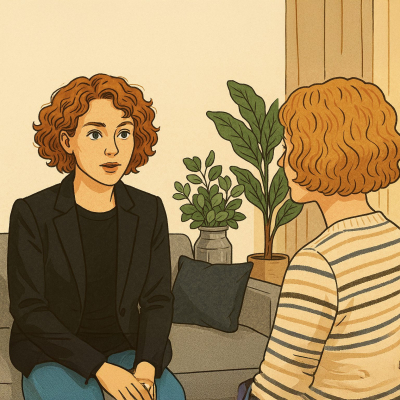
Single Session Therapy (SST)
Sometimes one well-focused conversation is what’s needed rather than a longer course of work. Single Session Therapy offers 75, or 90 minutes of focused attention on a specific question or difficulty, and previous clients also use it as a one-off check-in after longer-term work has ended. It isn’t the right setting for trauma processing or complex presentations, but for a specific issue where clarity and a different perspective would help, it can be genuinely useful. You can read more on the Single Session Therapy page.
Sessions are £95 and 50 minutes in length. Longer sessions of 75 or 90 minutes are available and can be particularly useful when working with trauma or dissociation. Sessions are usually weekly, and I work with clients on a longer-term basis as well as for more focused shorter pieces of work.
I see clients face to face at my practice in Bromley, South East London, and online via Zoom. Appointments are available during office hours and some evenings, subject to availability. There may be a waiting list for popular times.
