People often ask me a question that sounds simple. “Why don’t you just tell me what to do?”
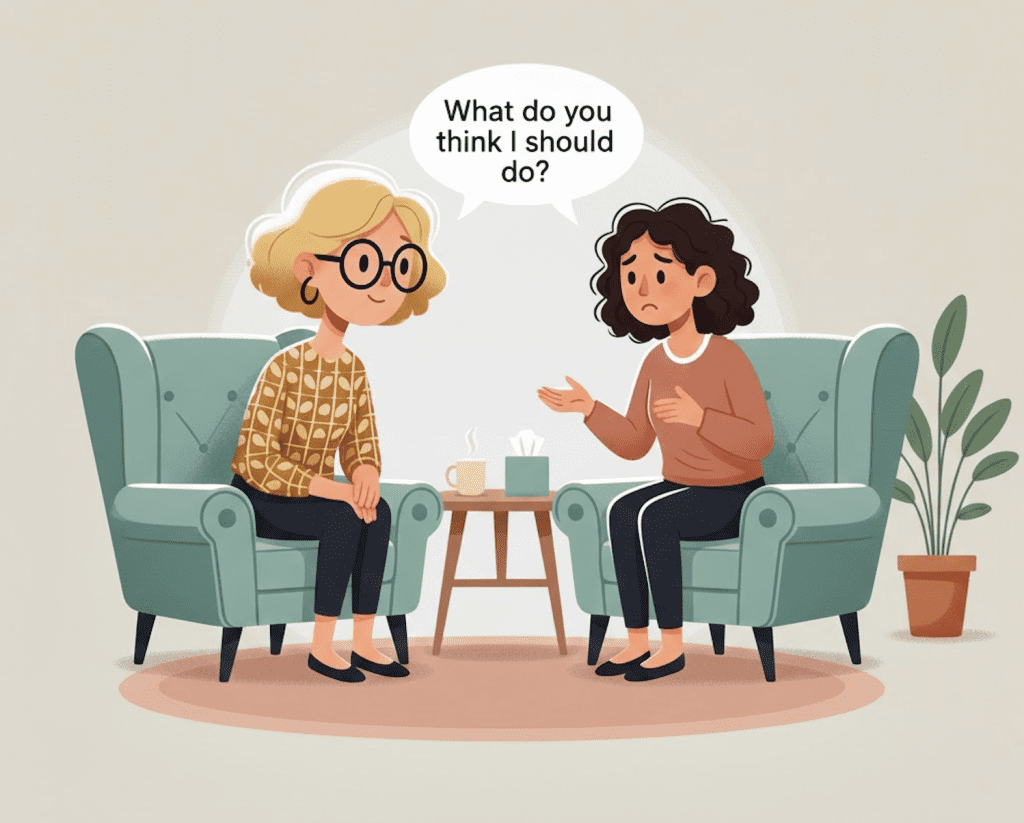
They ask it after they describe a week of circular thinking. They ask it when they feel trapped between two options that both look bad (or equally good!). They ask it when they feel tired of hearing themselves talk.
You ask for advice because you want relief. You want the noise to stop. You want a clean answer that you can carry out of the room like a receipt or action plan. You also want a sense that someone, somewhere, knows what the right choice is.
That wish makes sense. You make time in your life for psychotherapy. You bring the messiest parts of your life into a small room with a clock and a box of tissues. Of course you want something practical at the end!
So why do therapists avoid advice?
People come to therapy when their usual strategies stop working or seem confusing. You might talk to friends. You might read articles. You might listen to podcasts. You might make lists. You might still feel stuck. At that point, advice starts to feel like the missing ingredient. One good sentence from the right person, then you can act, then life will improve.
Sometimes advice does help. Sometimes it gives you a nudge. Sometimes it helps you name what you already know. But the moment you ask me to tell you what to do, you also tell me something else. You tell me you do not trust your own internal signals right now. You tell me you feel alone with the decision. You tell me you want to hand your uncertainty to someone who feels steadier. I understand that. I also take it seriously.
But here’s the thing, if I gave advice, you might feel better fast, then worse later. If I gave you advice, I would become a life coach. That is not a dig at coaching. Coaching can be very helpful. Advice can help. A good friend can help. A well timed “do this” can get you moving.
What we do instead, we build your clarity
I work as a psychodynamic psychotherapist. That means I pay attention to patterns over time. I listen for the roles you learned to play. I notice the feelings that appear right before you get stuck. I stay curious about the parts of you that speak softly, and the parts that interrupt them.
In practical terms, we look at questions like these.
- What do you want, before you edit it into something acceptable.
- What do you fear will happen if you choose for yourself.
- Who do you imagine you will disappoint. What old story does this decision tap into.
Clarity often arrives in small moments. Someone hears themselves say, “I do not want to be difficult,” and realises how many life choices hide inside that sentence. Someone notices they apologise whenever they feel angry. Someone realises they keep asking for advice from people they don’t even respect.
Then a different kind of decision becomes possible.
When you decide from clarity, you do not decide because have the answers. You decide because you feel more connected to the answer you found. You can tolerate the doubt that comes with an adult choice. You can hold the loss that comes with picking one option over another. You still might ask me what I think. You still might want reassurance. You can bring that too. I might offer an opinion and ask you how it lands but mostly I help you work out how you feel, what you need, how you should proceed.
Therapy does not give you my certainty. Therapy helps you build your own.
How I can help : Psychotherapy, not advice, in Bromley.
About me : Professional Background and Qualifications.
Contact me : Book an initial call.