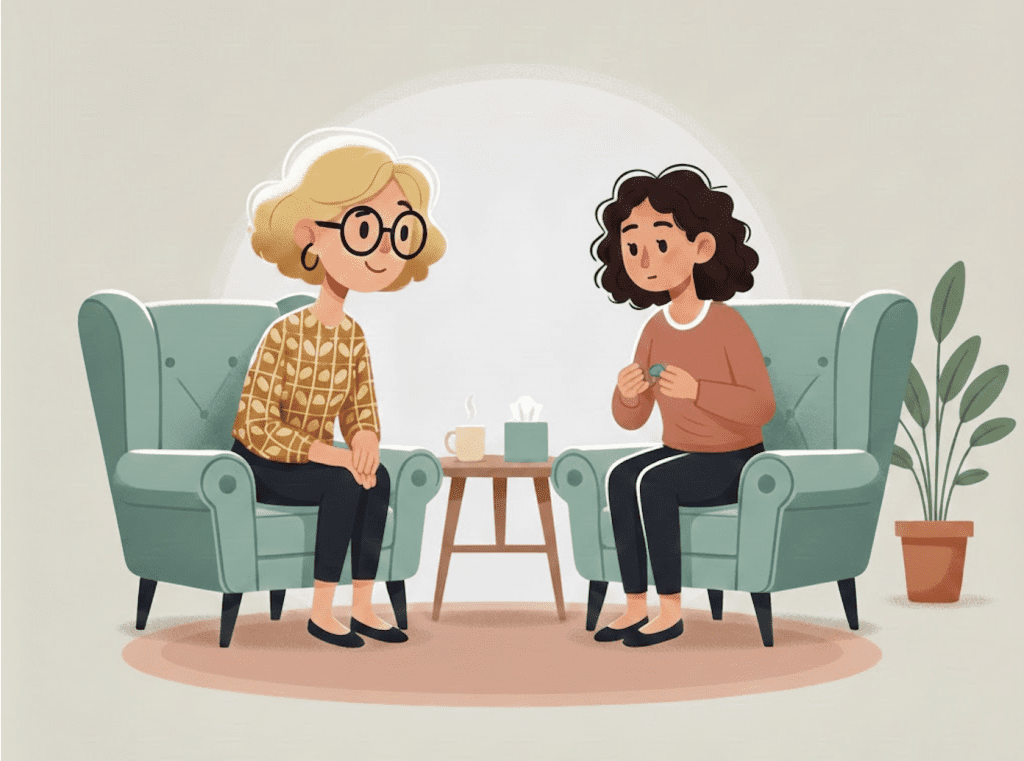
A late diagnosis often feels like finding the final piece of a puzzle. You might feel relief. You might also feel grief or confusion. Many adults reach this point after years of anxiety, burnout, or a sense that they are “wrong.”
You are not wrong. You are neurodivergent.
Language That Belongs to You
- Neurodiversity: The natural variation in human minds.
- Neurodivergent: A person whose brain works differently than the dominant norm. This includes Autistic people and people with ADHD.
- Neurotypical: A person whose brain fits dominant societal norms.
The Journey of Rediscovery
Late diagnosis or self-identification changes how you read your life story. Research shows common themes in this experience. You may re-evaluate your identity. You might rewrite old memories with new information.
Many people feel grief for missed opportunities for support. You may feel anger about years spent forcing yourself into environments that did not fit. In therapy, we sit with these big emotions. We do not rush to “fix” them. We honour them.
The Internal Tug-of-War: AuDHD
If you have both Autism and ADHD (AuDHD), you likely feel a “push-pull” pattern.
- You crave routine but struggle to maintain it.
- You seek novelty but hit sensory overload quickly.
- You look capable to others but feel behind inside.
I view these patterns as nervous system needs. They are not character flaws. They can make living in a world designed for neurotypical people feel overwhelming and difficult. I have heard this described as feeling like everyone else has the instruction manual to life while you are left trying to work out how everyone works.
The Hidden Cost of Masking
Masking is the act of hiding your traits to appear neurotypical. It is a survival strategy. Research confirms that masking helps people fit in, but the cost is exhaustion and a loss of self. ADHD adds another layer. You may spend years over-preparing, apologising, or hiding “time blindness.” From the outside, you look “high functioning.” From the inside, you feel constant strain.
A Deeper Approach to Therapy
My psychotherapy approach is psychodynamic. This means we look beyond worksheets or homework. We explore your history and how you learned to survive.
- Normalising: We validate your internal world.
- Grieving: We process the loss of the life you thought you “should” have had.
- Acceptance: We move toward a life that fits your actual brain.
Why You Were Missed
Many women and high-masking adults are missed by clinicians. Research shows that girls often show a “catch-up” effect, receiving diagnoses much later than boys. This delay causes harm. You may doubt your own experience because you learned to look “fine”. You may even have received the wrong diagnoses and now find yourself having to unpick what might be neurodiversity and what belongs to other labels you’ve been given.
Moving Forward
Therapy is not about fixing your neurotype. It is about building a world that fits you. This includes:
- Reducing shame through psychoeducation and understanding.
- Processing the anger of late discovery and missed opportunities.
- Managing emotional regulation and sensory load.
- Focusing on belonging and self-acceptance.
You do not need to prove your struggle to deserve support. You deserve a space where you are seen and understood.
Using Words and writing to Understand Feelings
Writing for wellbeing can support you in therapy with me, outside of therapy, or between sessions. You can keep it fully optional. You can write a few words, a list, or a short paragraph, or you can skip it completely. You can also keep your writing private. You never need to show it to me unless you want to. If you do bring something, you can share it silently, summarise it, or read it out loud. You control the pace and the level of detail, and reading anything out loud stays entirely optional. This can also help you keep therapy focused on what matters most to you, so we use your session time well.
Bibliotherapy and poetry therapy offer another gentle route into emotion and meaning when you are not sure what you are feeling, you can explore them with me or on your own. Bibliotherapy uses carefully chosen books, stories, or guided self-help materials to support insight, coping skills, and self-understanding. Poetry therapy uses poems and short writing to help you express feelings with a little
distance, especially when direct language feels hard. Song lyrics can work in a similar way. You can bring lines that stick in your mind, match your mood, or describe something you cannot quite say yet. In sessions, we can use a short excerpt from a poem, a passage, or a lyric as a starting point to identify feelings, track body cues, and clarify needs and boundaries, without forcing you to explain everything at once.
How I can help : Psychotherapy for Late diagnosed ADHD and Autism in Bromley
About me : Professional Background and Qualifications
Contact me : Book and initial call
Resources
National autism support
- National Autistic Society. Adult support. Local groups directory. Work and benefits guidance. Helpline information… www.autism.org.uk
- Autistic Girls Network. Information and support focused on girls and women, useful for late identification… autisticgirlsnetwork.org
- Ambitious about Autism. Resources for autistic people and families, including education and employment support… www.ambitiousaboutautism.org.uk
- Autism Central. Information and guidance for families and carers in England… www.autismcentral.org.uk
National ADHD support
- ADHD UK. Adult ADHD information and support. Signposting… adhduk.co.uk
- ADDISS. Information and support for ADHD… www.addiss.co.uk
References
Cage, E., Di Monaco, J., & Newell, V. (2018). Experiences of autism acceptance and mental health in autistic adults. Journal of Autism and Developmental Disorders, 48, 473–484
Hull, L., Petrides, K. V., Allison, C., Smith, P., Baron-Cohen, S., Lai, M.-C., & Mandy, W. (2017). “Putting on my best normal”: Social camouflaging in adults with autism spectrum conditions. Journal of Autism and Developmental Disorders, 47, 2519–2534.
Stagg, S. D., & Belcher, H. (2019). Living with autism without knowing: Receiving a diagnosis in later life. Health Psychology and Behavioral Medicine, 7(1), 348361.
Neurodiversity terms and definitions
UCLA Health. (n.d.). Understanding undiagnosed autism in adult females.
The Independent. (2025). Reporting on Swedish cohort findings on autism diagnosis
timing differences by sex.