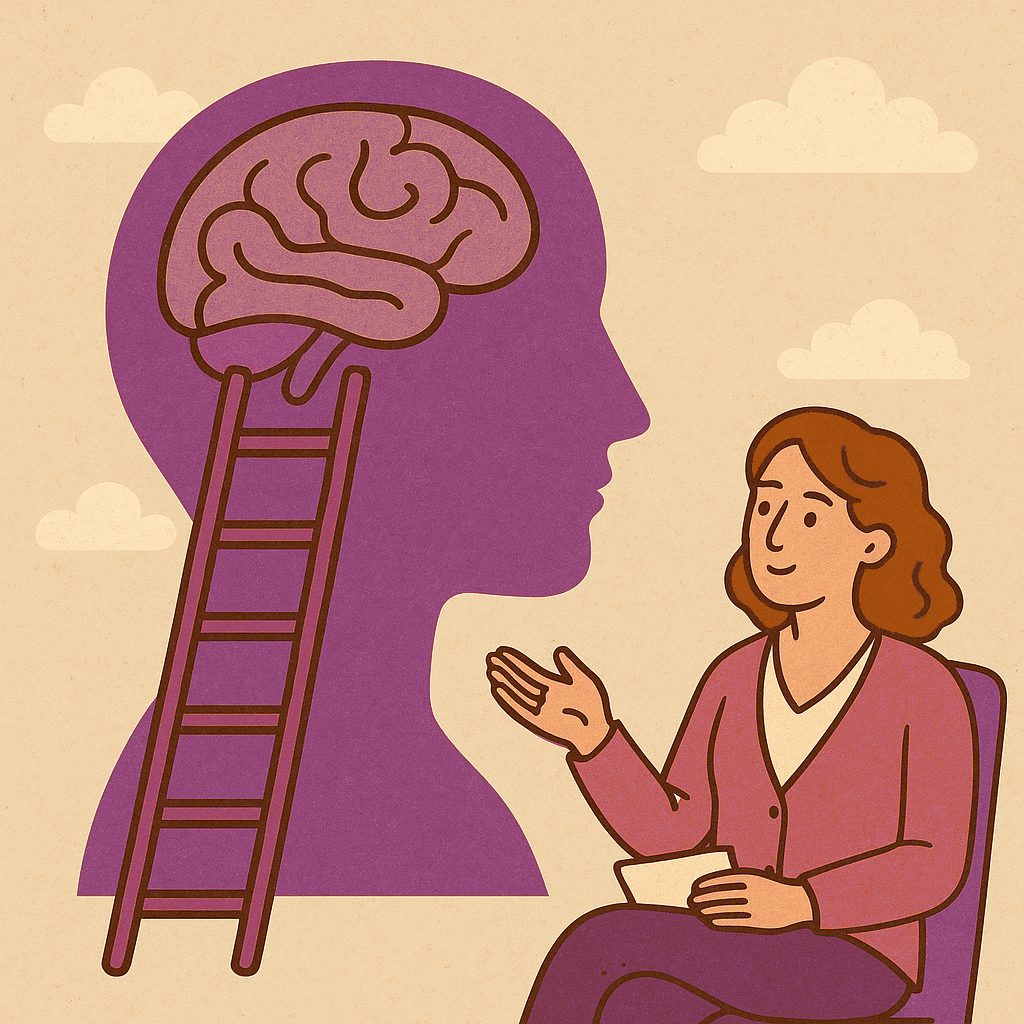
One of the things that becomes clear in relational therapy is how intelligent our defences are. Intellectualising, the tendency to analyse, explain, and think our way through experiences rather than feel them, isn’t a failure of emotional awareness. It’s a sign that somewhere along the line, staying in the head felt considerably safer than dropping into the body and its unpredictable emotional life.
If the people around you when you were young didn’t respond well to your sadness, your fear, or your anger, you learned quickly. Emotions became something to manage rather than express. Thinking became the reliable exit route, fast, efficient, and far less exposed than feeling. That’s not a character flaw. It’s an adaptation, and a sophisticated one.
What Intellectualising Actually Looks Like
You might recognise it in yourself as a tendency to narrate your experience rather than inhabit it. You describe what happened in careful, considered terms. You analyse the dynamic, name the pattern, reference what you’ve read. You can talk about your childhood with impressive clarity and almost no emotion. In conversation, you often move toward explanation before you’ve had a chance to notice what you actually feel.
This can be confusing in therapy, because you arrive articulate and self-aware, which looks like good therapeutic material, and it is, but there’s sometimes a gap between the understanding and the felt experience. The insight is real. The emotion it belongs to is still at a distance.
None of this is a problem to be corrected. It’s information about what felt safe, and what didn’t.
What This Tells Me as Your Therapist
When I notice intellectualising in the room, my response isn’t to challenge the defence or try to push past it. It’s to get curious about it. What’s being protected? What might be underneath the analysis, if there were enough safety to let it surface?
I might ask: if you didn’t have to think your way through this right now, what do you imagine you might feel? Or: what’s the risk of feeling something rather than understanding it? These aren’t trick questions. They’re an invitation to notice what the thinking is doing, not to replace it, but to bring it into view.
Sometimes the answer is another layer of analysis, and that’s fine too. The door doesn’t need to be flung open. It just needs to be acknowledged as a door.
How This Changes in Therapy
Defences shift not because they’re confronted but because the conditions that made them necessary begin to change. When the therapeutic relationship feels genuinely safe, when emotions can be brought into the room without consequence, the nervous system gradually learns that it doesn’t need to keep the same guard up. The thinking part doesn’t disappear. It just stops having to do all the work alone.
This is slow, patient work, and it moves at the pace of trust rather than insight. You don’t need to arrive in therapy ready to feel everything. You just need to be willing to get a little curious about why you’d rather not.
My work is rooted in relational psychodynamic therapy, which means I pay attention to what happens between us in the room as well as what you bring from your history. If thinking has always felt safer than feeling, that will show up in our work together, and that’s exactly where the most useful conversations tend to happen.
If this resonates and you’re wondering whether therapy might help, get in touch at samanthamerry.co.uk/contacts.
Resources worth exploring:
The Attachment Project on YouTube, for accessible explanations of how early attachment shapes adult emotional life and relationships
The Drama of Being a Child by Alice Miller, a concise and precise account of how emotional suppression develops in childhood and what it costs in adult life, written accessibly for a general reader
It’s Not Always Depression by Hilary Jacobs Hendel, which introduces the Change Triangle as a practical model for understanding the relationship between defences, emotions, and the inhibitory feelings that keep them out of reach
Emotional Inheritance by Galit Atlas, on how unprocessed emotional experience moves through families, often without words, and what it takes to interrupt that
Therapist Uncensored podcast, particularly episodes on defences, avoidant attachment, and the neuroscience of emotional regulation