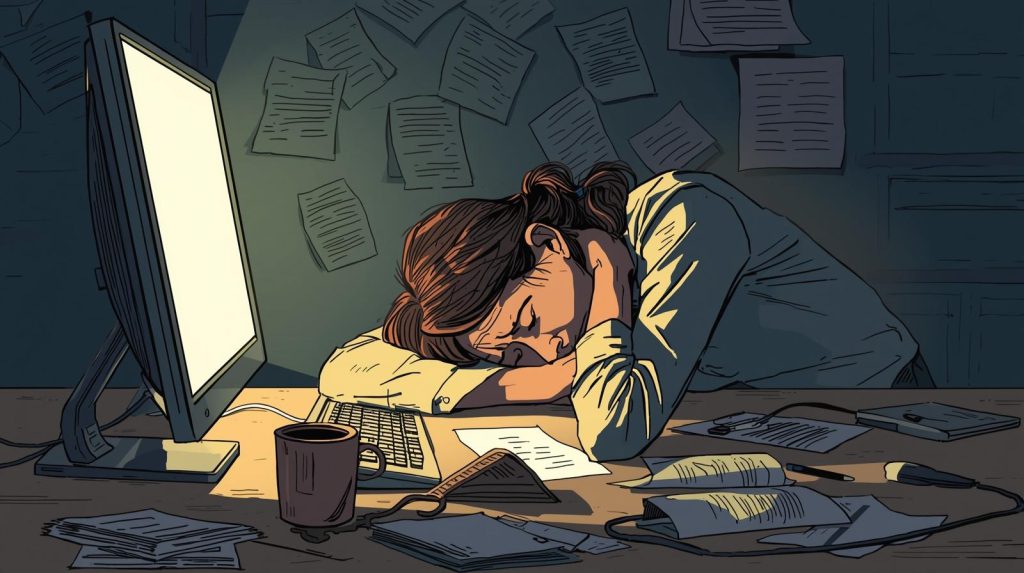
Burnout rarely announces itself clearly. It tends to accumulate quietly, in the gap between what you’re giving and what you’re getting back, until the point where ordinary demands start to feel unmanageable and the capacity to recover between them has gone.
It doesn’t always look dramatic. Often it looks like someone who is still functioning, still showing up, still meeting their commitments, but doing so on reserves they stopped replenishing some time ago. The tiredness doesn’t lift with sleep. The things that used to feel meaningful have gone flat. There’s a quality of going through the motions that wasn’t there before.
Burnout can arrive through sustained workplace pressure, through caring responsibilities, through a health change that shifted what you can carry, or through the accumulated weight of managing yourself in an environment not designed for how you work. For many people it has roots that go deeper than the immediate circumstances, in early patterns of over-functioning, in a difficulty with limits, in the belief that rest has to be earned.
Menopause and Burnout
Midlife women are significantly overrepresented in burnout presentations, and the reasons are rarely just professional. The hormonal changes of perimenopause and menopause directly affect sleep quality, emotional regulation, and cognitive clarity. When those changes are happening alongside sustained workplace demands and domestic responsibility, the cumulative load can become genuinely unmanageable.
What makes this harder is that the experience is often invisible in professional contexts. Many women describe feeling that naming menopausal symptoms at work would be seen as weakness or unprofessionalism, so they manage it privately while continuing to perform at a level that the internal experience no longer supports. That gap between the external performance and the internal reality is exhausting in itself.
In therapy, we start by naming what’s actually happening, which is often a relief in itself. We look at where the pressure is coming from, what beliefs are driving the over-functioning, and what the barriers are to asking for what’s needed. We also make space for the grief that can sit underneath burnout at this life stage, around identity, around the body changing, around roles that are shifting in ways that haven’t been fully acknowledged.
Neurodiversity and Burnout
Autistic and ADHD adults often describe working environments as ones that require sustained effort to navigate even before any specific stressor is added. The sensory demands, the social expectations, the need to mask natural responses in order to fit a neurotypical norm, all of this carries a hidden cost that doesn’t show up in performance reviews but accumulates steadily over time.
Autistic burnout in particular is now well-documented in the community and clinical literature. It involves long-term debilitating fatigue and a loss of previously manageable functioning, typically triggered by a sustained mismatch between demands and the resources available to meet them. It’s distinct from general burnout and often more severe in its impact on everyday capacity.
In therapy, we look at what’s actually draining energy rather than working from a generalised assumption about what ought to be manageable. That might mean identifying that a particular kind of meeting, or a particular social demand, consistently costs more than it’s acknowledged to. It might also mean examining the internal pressure to perform neurotypicality, the harshest version of which is often a voice formed in environments where fitting in felt necessary for safety. Loosening that internal standard is usually where some of the most significant energy returns.
Practical boundary language is part of this too. Requests like “I work best with a written agenda in advance” or “I’ll join this one by audio only” aren’t workarounds. They’re accurate descriptions of what allows sustainable functioning, and learning to make them without guilt is genuinely therapeutic work.
Workplace Stress and the Limits of Resilience
Burnout from workplace stress is frequently met with resilience frameworks, time management strategies, and self-care advice. These aren’t useless, but they tend to address the surface without touching what’s underneath. If the pattern of over-functioning predates the current job, the current team, or the current demands, a productivity tool won’t reach it.
Psychodynamic psychotherapy offers something different. The therapy room becomes a space to understand how you’ve learned to relate to demand, to limits, to your own needs, and to the expectation of others. Old patterns of coping, over-delivering, self-silencing, the difficulty with saying no, can be noticed and understood in the present rather than simply repeated. What changes in that space can be carried into the rest of life, making recovery more durable than it would be through adjustment alone.
Working With Me
I work with adults experiencing burnout across these different contexts, including where burnout intersects with menopause, neurodivergence, or chronic relational patterns that have been driving over-functioning for years. My approach is relational and psychodynamic, and I’m interested in what’s underneath the exhaustion as much as the exhaustion itself.
If you’d like to explore what therapy for burnout might involve, I’d be glad to have an initial conversation. Get in touch at samanthamerry.co.uk/contacts.
Resources worth exploring:
- Rest is Resistance by Tricia Hersey, a powerful argument for rest as a political and personal act, written with urgency and warmth, particularly relevant for those whose burnout is rooted in an inability to stop
- Unmasking Autism by Devon Price, a psychologist and autistic author writing about the costs of masking and what recovery from autistic burnout actually involves
- Burnout by Emily and Amelia Nagoski, written specifically for women, with a clear account of the stress cycle and why completing it matters for recovery
- The Menopause Charity (themenopausecharity.org), for clinically accurate information on how hormonal changes affect mental health and working life
- Autistic UK (autisticuk.org), a community organisation led by autistic people, with resources on autistic burnout and self-advocacy
Samantha Merry is a BACP Senior Accredited Psychotherapist in private practice in Bromley, South East London, and a doctoral researcher at the University of Chester.